Syllabus
Catalog description: An introduction to database design and management with emphasis on data definition, data manipulation and query languages found in modern database management systems. 3 credits.
Prerequisite: A grade of "C–" or better in CS 240 or CS 343 or equivalent.
Tu/Th 9:30–10:50am in King Hall 260
Dr. Mona Rizvi, Associate Professor of Computer Science

Email: elkadima@jmu.edu | Office Phone: 540-568-2775
The best way to contact me is by email or Telegram @maerizvi.
Office Hours in King 253:
- Mon 1:00–3:00pm,
- Tues 11:00am–12:00pm,
- Thurs 1:00–3:00pm
- OR online by appointment
Course Objectives
By the end of CS 374, you should be able to:
- Summarize features of the relational model including structured data, relational operations, and integrity constraints.
- Construct a conceptual model (E/R diagram) and a physical model (relational design) from a general data description.
- Illustrate anomalies and inconsistencies that can occur within a database design and how to correct them.
- Write analytical queries in SQL (select, project, inner/outer join, grouping, aggregation, sorting, distinct, subqueries).
- Design and implement a substantial three-tier application, both individually and with others.
- Manage a successful semester-long team project (communication, source control, frequent code reviews).
Last but not least, you should have fun exploring and working with several exciting database technologies this semester!
Required Textbook
Painter‑Wakefield, Christopher. (Aug 2023). A Practical Introduction to Databases. Runestone Academy.
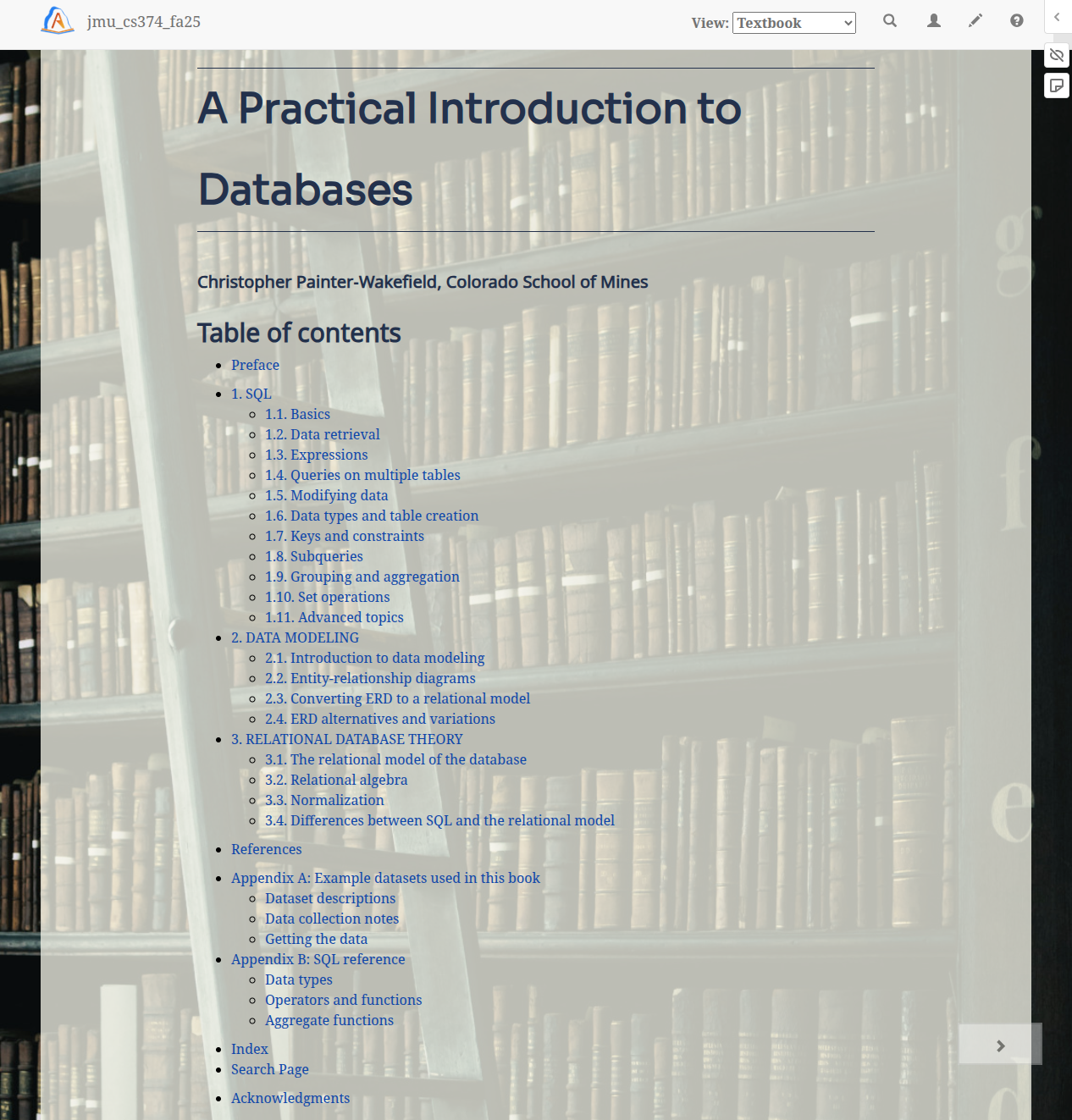
"This book was created to fill the need for a low-cost [free], up-to-date textbook suitable for an introductory course on databases… The book is oriented to students encountering databases for the first time, with a focus on key skills needed by future software engineers."
Getting the Book
- Be sure to access the book through the Canvas assignments.
- All of your book progress will be recorded, regardless of which assignment you access it through.
Culture of Learning
Please help us maintain a collaborative environment that encourages questions, provides opportunities for significant learning, and actively involves everyone in discussions.
Professional Conduct
The ACM Code of Ethics (https://www.acm.org/code-of-ethics) forbids discrimination and harassment of all types. If you believe someone is violating these principles (e.g., by making inappropriate or demeaning remarks), it is your responsibility to take action by informing me or, if you feel comfortable doing so, addressing the individual directly. I will do my best to preserve your confidentiality when addressing the issue.
Inclusive Excellence
Learning environments should be built on mutual respect and support a diversity of thoughts, perspectives, experiences, and identities. Please advise me regarding any concerns or personal circumstances (including your name's proper pronunciation, any name or pronouns not reflected on MyMadison, or significant extracurricular commitments) that would be relevant to your full participation in this course.
Academic Honesty
Don't Cheat
Students who violate the Honor Code (https://www.jmu.edu/honorcode/code.shtml) will receive a reduced or failing grade in the course. Other penalties may be imposed, and all violations will be reported to the Honor Council. Automated tools may be used on any assignment, at any time, to detect inappropriate collaboration and the originality of submissions.
Generative AI
You may use AI technology in general ways that support your learning. However, do not ask ChatGPT or similar tools to do your homework or in-class activities for you. AI will not be available during exams, so make sure you can program without AI. See the Student Guide to Artificial Intelligence for examples of appropriate use.
Methods of Evaluation
Reading
Your reading progress will be measured by questions embedded in the book. Reading from other sources may be checked by short quizzes.
In-class Activities
You are encouraged to work with other students during class. In-class activities and out-of-class readings have points, because your participation impacts your success and others'. If you are occasionally absent, you will have the opportunity to make up missed work. In-class activities will be scored by the instructor based on your participation in class, and some will also require a submission into Canvas or Gradescope. Points will be given according to the following:
- 0 - no participation/submission
- 1 - partial participation and/or partially correct submission
- 2 - full participation and/or correct submission
- (3) - 3 points may sometimes be given for a 2-point assignment at the discretion of the instructor.
Homework
To help prepare you for the exams, you will complete individual homework assignments. Written assignments will be submitted electronically via Canvas or Gradescope.
Groupwork: There will not be a single, continuous group project in this course, but there may be some homework assignments that can be completed in a pair or group.
Work must be Explainable
You must be able to explain any part of your homework solutions to the instructor upon request. If you are unable to explain your solution(s), you may not get credit for the work.
Late Work Policy
Deadlines exist so that we can discuss solutions in class. Therefore, late work will not be accepted without special permission. I am willing to work with you if your circumstances suddenly change. Please don't wait until the night before to get started!
Tests and Exams
This course is inherently cumulative; each week builds on the prior weeks. There will be 3 in-class tests throughout the semester and a final exam. The content and format of the exams will be similar to the assignments.
Grading Criteria
Your grade in CS 374 will be based on:
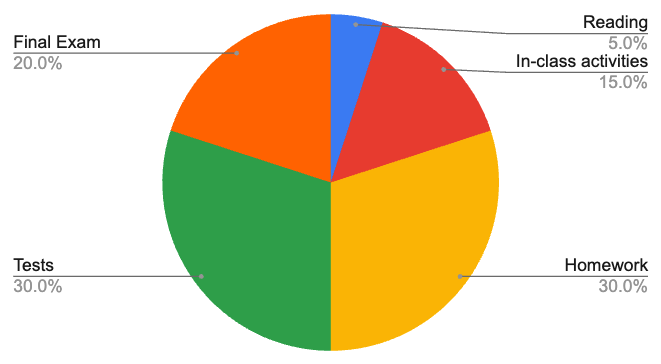
Letter grades will be assigned on the scale A=90–100, B=80–89, C=70–79, D=60–69, F=0–59, with potential minor adjustments after considering the overall performance of the class and actual distribution of numeric scores. We will use + and – grades at our discretion. We do not assign WP or WF grades except in unusual circumstances.
University Requirements
Adding/Dropping
You are responsible for enrolling in courses and verifying your schedule on MyMadison. The last day to add a semester course without department permission is Friday, 01/30/2026. The last day to withdraw from a course with a W grade is Friday, 03/27/2026.
Attendance Policy
You are expected to participate in every class. We understand that things come up, and you might need to be absent occasionally. That's why we provide make-up opportunities for in-class work. If you are not feeling well or suspect you might be ill, please stay at home.
Disability Services
If you have a documented disability and need accommodations in this course, please register with the Office of Disability Services (http://www.jmu.edu/ods, Student Success Center, Room 1202, 540-568-6705). ODS will provide you with an Access Plan Letter to verify your need for services and make recommendations for the course.
Excused Absences
Students who are unable to attend class due to JMU sponsored activities (such as sports, band, academic competition, field trips, etc.) or personal religious observances may request reasonable accommodations. Please notify me during the first week of class regarding potential absences so that you and I can plan ahead.
University Closings
Given severe weather and other unexpected circumstances, be sure to watch for announcements relating to make-up dates. See http://www.jmu.edu/JMUpolicy/1309.shtml for JMU's cancellation policy. Although the schedule may adapt to canceled classes, assignment deadlines generally do not change.
Your Well-Being
As a university student, there may be times when personal stressors interfere with your academic performance and/or negatively impact your daily life. If you or someone you know is experiencing mental health challenges at James Madison University, please connect with the Counseling Center located within the Student Success Center on the 3rd floor. You can learn more about available services by visiting https://www.jmu.edu/counselingctr or calling 540-568-6552. These services are free and confidential. Other available support resources to consider include, but are not limited to, the Office of the Dean of Students, the Health Center, and Learning Strategies Instruction.