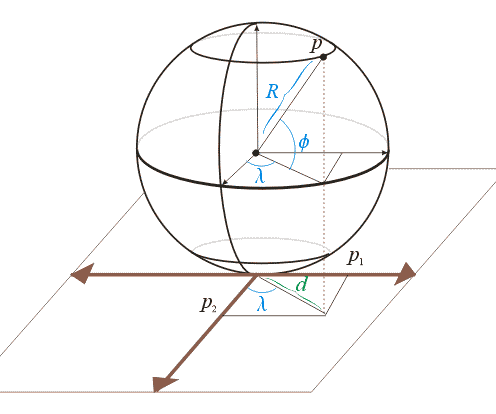
\(p_{1} = \lambda R\) since it is only determined by
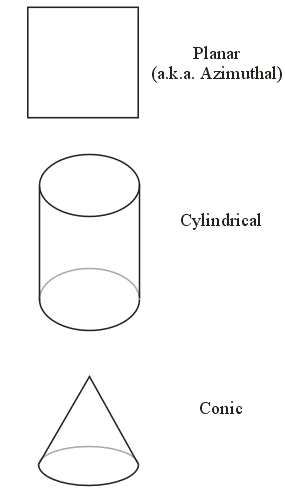
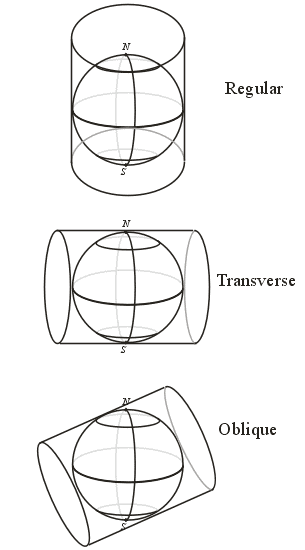
where the cylinder is "cut"
Derivation of the Inverse:
\(\lambda = p_{1}/R\)
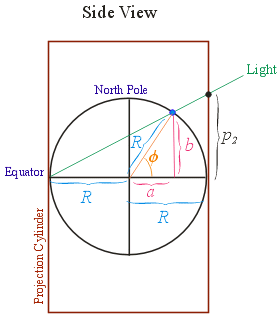
\(\tan \phi = p_{2}/R \Rightarrow
\phi = \tan^{-1}(p_{2}/R)\) (but you have to be careful
about the domain of the \(\tan\))
Desirable Properties of Projections
The Most Common:
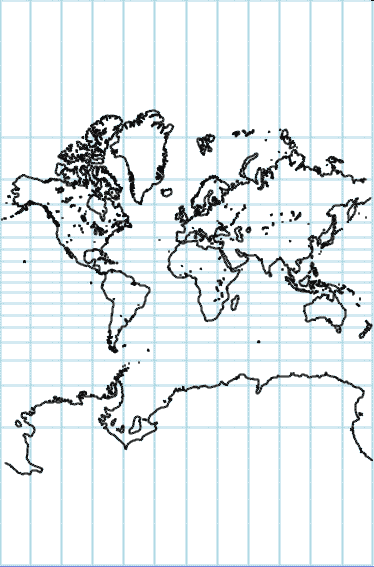
Conformal (i.e., angles are preserved locally so shapes
appear "true")
Equal Area (i.e., areas are in constant proportion)
Note: A single projection can not be both conformal
and equal area
Somewhat Less Common:
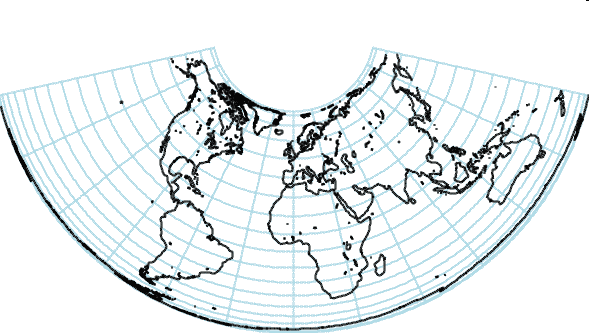
Equidistant (i.e., distances are in constant proportion, but
only from certain points or along certain lines)
Desirable Properties of Projections (cont.)
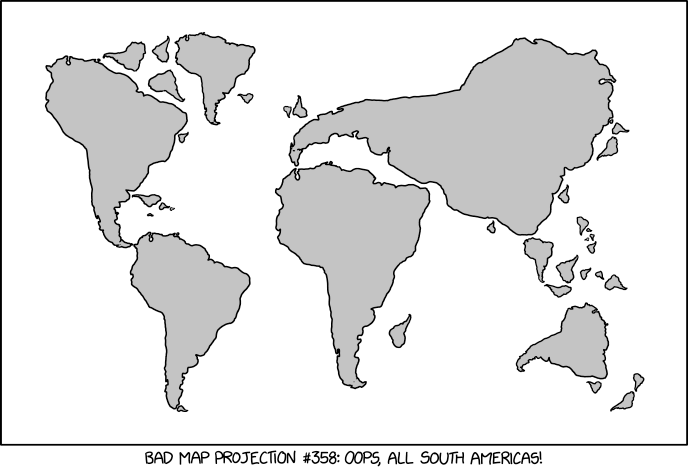
Nerd Humor - Bad Map Projection: South America
(Courtesy of xkcd)
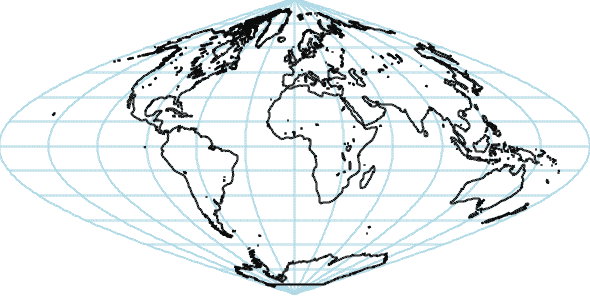
Sinusoidal (Sanson-Flamsteed) Projection
"Casual Derivation" of an Equal Area Projection:
The "circumference" of a line of latitude (i.e., a parallel)
is \(2 \pi R \cos \phi\)
We want \(\frac{d p_1}{d \lambda}\) to be proportional
to the "circumference", so
\(\frac{d p_1}{d \lambda} = k R \cos \phi\)
We want \(\frac{d p_2}{d \phi}\) to be proportional
to the radius, so \(\frac{d p_2}{d \phi} = h R\)
We can simplify by imposing the conditions that the scale
factors are 1 (i.e., \( h = k = 1\)).
\(\frac{d p_1}{d \lambda} = R \cos \phi \Rightarrow
p_1 = R \cos \phi (\lambda - \lambda_0)\), where
\(\lambda_0\) is the reference longitude that we can
set to 0.
\(\frac{d p_2}{d \phi} = R \Rightarrow p_2 = R \phi\)
Interpretation:
\(p_2 = R \phi\) means that the parallels
are evenly spaced.
Given this, the projection preserves area because
the length of each parallel equals the "circumference".
Sinusoidal Projection (cont.)
The World
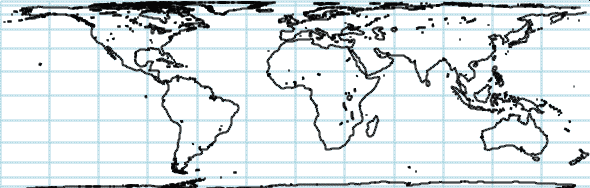
Equatorial Cylindrical Equal Area Projection
Parameters:
\(\lambda_{0}\) is the standard longitude
(i.e., the horizontal center of the projection)
Projection:
\(p_{1} = R (\lambda - \lambda_{0}) \)
\(p_{2} = R \sin(\phi)\)
Inverse:
\(\lambda = \lambda_{0} + \frac{p_{1}}{R}\)
\(\phi = \sin^{-1}(p_{2} / R)\)
Equatorial Cylindrical Equal Area Projection (cont.)